The Entire Star Trek Universe at High Speed

Showing posts with label Pilot. Show all posts

Sunday, October 4, 2009

Response to the Nine Year Old View: No Man


Sabrina 9 years old brings up an interesting question at the end of her summary of "Where No Man Has Gone Before." She says she doesn't know why the doctor dies helping to kill Mitchell in the end. The doctor had apparently the same powers as Mitchell, and yet uses them to dutifully help Captain Kirk in the annihilation of Mitchell's evil super powers (by fighting, and so weakening, Mitchell himself). Sabrina 9 years old asks why the doctor is able to do so when Mitchell's powers clearly make him evil. That is, why is the doctor able to be good when it appears that the powers themselves make people evil.

Towards the end of the episode when the Psychiatrist (who we've called the doctor here) has developed her ESP abilities enough that they have become visible to the viewing audience, she appears to be under the sway of Mitchell. The two of them leave the confinement on the planet that the ship's crew had placed him in, and it is clear Mitchell intends to provide anything they need while the Psychiatrist's own powers further develop. At this point Captain Kirk appears in his attempt to kill Mitchell. Mitchell's powers have developed to the point that there is clearly (from Kirk's point of view) no other choice but to kill Mitchell. Though we are meant to expect that killing Mitchell verges on impossible.

Mitchell anticipates Kirk's advancing, however, and sends the Psychiatrist to talk with Kirk believing that she will see how "useless" humans are to them now and perhaps undo Kirk herself. Kirk pleads with her though, asking her to think about and pay attention to Mitchell's behaviors. If she does, he says, she will see that Mitchell is using them only for ill. He asks the Psychiatrist to, please, be human just a little longer; to, please, be a counselor for just a little longer. That is, to see what is really going on with Mitchell, and so what must be done by Kirk with her help. The implication here, in Kirk's account, is that she too will succumb to evil doing if she allows her own ESP to continue to develop as Mitchell's has. We might say that the answer to Sabrina 9 years old's question, then, is that the powers simply make a person evil, but it takes time and the Psychiatrist hasn't suffered under enough time yet.

But I think such an answer would be too limited a view of the ethical under currents of the episode. Mitchell showed himself to be power hungry, and without regard for others almost as soon as the anomaly shocked him. It's clear that in the moments when the ESP faded (it would fade briefly when he was shocked by other types of electrical sources) Mitchell would return to his previous self confused, and with some level of regard for his long term friend, Kirk. The entire time the ESP has shown itself in him, however, such regard has been entirely absent. Instead, he has reveled in what he can do to, and what he can know about, others because of the powers.

The doctor, on the other hand, has been fascinated with Mitchell's developing powers since they first took hold. But her fascination has been accompanied with feeling for the person, specifically Mitchell, not simply with lust for the powers themselves. Her character has been sympathetic to, and wanting to help the person that is Mitchell from the beginning. Then, too, when her extra-ESP finally takes hold (with her eyes turning silver as Mitchell's have), we see that her new powers do not develop as bold, driven powers in the way that Mitchell's appeared. Instead, her powers seem accompanied still with the enhancement of that feeling for we've seen in her from the beginning. So, when Kirk appears, she feels great sympathy for the situation--both towards Mitchell and what he has gone through in the immense change, and for Kirk in the difficulty of the situation he faces (killing his old friend).

This pilot presents a sort of character revealing circumstance in which we can see how prepared Kirk would be to act as Captain--he's smarter than a man equipped with only logic, he can make difficult choices like killing an evil-turned friend, and he can surpass the impossible by killing that friend whose power it appeared had become almost omnipotent. Interestingly, in the midst of all this, we are supposed to understand that Kirk has suffered a serious personal challenge in this episode. We are told that Mitchell is his long term friend. Indeed, the two of them regale each other with multiple stories of their shared past as the episode progresses. There is some pausing on Kirk's side early on when the initial decision to kill, or abandon Mitchell must be made. But by the end of the episode the feeling over the situation--loss of a friend, loss of a ship mate--is expressed primarily through the character of the female Psychiatrist, rather than through Kirk himself. The drama closes with her expressing insight into the challenge of the situation, without Kirk clearly responding or saying anything about the situation himself. It is in this way that the episode resembles the T.V. Western so popular at the same time. The cowboy of the 1960's television drama regularly suffers the loss of a friend in the midst of a gun fight with a band of outlaws, or a tribe of Indians. But in the face of that loss his feelings are expressed through stoic resolve. The Kirk of Peeples's pilot operates with this same desert dusted stoicism. In the end of the episode, his regard for the two--Mitchell and the Psychiatrist--occurs only in stiff, bureaucratic protocol when we see him enter into both of their records that they died fulfilling their duty. We are simply meant to understand that doing so makes Kirk a noble figure, rather than clearly feeling that it does. It is here that we can come to understand two things, then.

First, the female psychiatrist did develop her ESP inclinations further, just as Mitchell had further developed his. But Mitchell's were acted out through the kind of classic evil masculine resolve common to the time, while hers had to be enacted through the feminine sensitivity she represented in the episode. She tested high in her ESP powers before the anomaly encountered them, just as Mitchell had. But we can see that her development was around feeling other peoples feelings, a kind of early prototype for Belana Troy. Mitchell, instead, tested high, it would seem, on being able to control physical and material concerns, a different sort of ESP-type power.

Second, it is in the stoic nobility of Kirk that we can see the obvious departure from Roddenberry's pilot. As I mentioned in my earlier post, Roddenberry's pilot is far more intellectually focused in the sense that it is illustrating, and teaching particular moral lessons and principles than Peeples's is. But that is not the only important divergence to be seen. It is not simply a matter of moral principle that separates the two pilots. Peeples's captain rules with a stoic, desert demeanor, while Roddenberry's would have operated through passionate reason, a reason deep with feeling. Kirk's exhibitions of passion appear as a sort of arrogant spontaneity (admittedly only hinted at here in comparison to how clearly this trait develops in the later Kirk), while Pike's passion arises through well thought out deliberation and execution--an integral part of what it means to be a well developed deliberator. Roddenberry, then, appears to have written a true Aristotelian into his captain's seat. Something that can't be said for Peeples's Kirk.

No Man: The 9-year old perspective

"Where No Man Has Gone Before" scared me a little bit because of the way their eyes turned silver, and, you know, it glowed, that scared me. But, once Mitch started getting powers, and he turned evil because of it, and he had been a really nice guy, but that's how it went, and he got shocked by this thing, I'm not quite sure what it was, so I'll give you a quick little summary of what happens. So, Spock was listening to this radio thing from a crash spaceship from years ago and so basically the pilot had to blow it up because one of his men had turned, you know, evil, because of the shock. So, basically the same thing happened to their ship as the other, except they didn't blow up the ship. So, they come into an earthquake, or something like that. And two of the characters get shocked but something only happens to one of them, which was Mitch, and he started getting powers. And basically tried to take over the spacecraft. So, they talked and decided they'd have to either kill him or desert him on a near by planet. So, they went to a planet so they could desert him. But he talked one of the doctors into turning into a person, or something. She started to fall for his trick, so she turned into one too. But the captain finally was able to kill Mitch, because there was no way to turn him back into his regular self, and the doctor that turned like Mitch died on the planet because she was trying to help to kill Mitch. (I don't know, she just turned good all of a sudden, but she still had the powers.)

New Ground: Pilot 2, a.k.a., Episode 3


TOS: The Second Pilot, a.k.a., Season One, Episode Three: Where No Man Has Gone Before

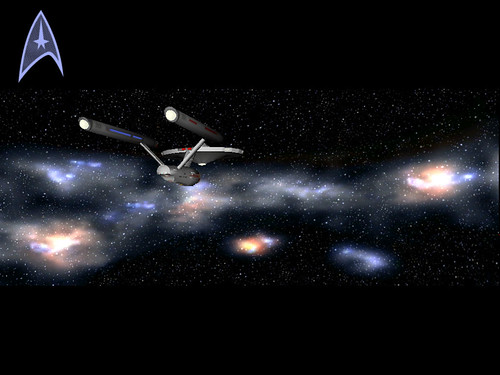
The anomaly encountered by the Enterprise in "Where No Man Has Gone Before"


"Where No Man Has Gone Before" was filmed and aired as the pilot of Star Trek after NBC rejected the original pilot written by Roddenberry. Eventually, the episode was also aired as the third of the first season, once the original series began to run regularly. When NBC rejected Roddenberry's pilot, it turned to Samuel Peeples, an established writer of westerns, to construct the new pilot episode.

"The Cage" highlights psychological issues that Roddenberry hoped to explore with the series. While "Where No Man Has Gone Before" doesn't show itself as quite so intellectual as the Roddenberry pilot, Peeples's pilot still focuses on heavily psychological issues. "The Cage" offers clear moral lessons for its viewers, whereas the kind of psychological exploration to be seen in "No Man" is more about creating high drama. It appears less as a space drama than later Star Trek becomes in that it doesn't exhibit the unique factors that life in outer space would offer a series. Instead, this episode uses only the science fiction elements of mutation and extra sensory powers to its advantage, channeling them into the service of a highly dramatic hour long episode.


Episode Quick-Summary

Captain Kirk's crew intercepts a strange radio signal that turns out to be an old ship's recording device. They bring it on board so that Spock can listen to its records and analyze the information. Spock discovers that the device's ship was destroyed by its own captain for reasons associated with Extra Sensory powers (ESP). The Enterprise's resident psychiatrist, Dr. Dehner, knows a little bit about ESP, and, it turns out, tests high on such powers. Quickly, the ship encounters a strange anomaly, that they discover the previously destroyed ship had also encountered. Only two members of the crew are affected by the anomaly, however, Helmsman Mitchell (an old friend of Kirk's), and the Psychiatrist herself. The effects, we discover, are the stimulation of their own ESP to become even more powerful than before.

Episode Tidbits
Multi-level chess opens the episode, which is charming partially for how heavily it is featured later in The Next Generation (TNG). There, of course, we have no Spock, but Data instead, the character that would seem the natural expert in chess for his systematic intelligence. In this episode, however, we discover Kirk's intelligence, as he is beating Spock in play. Spock reminds us later in the episode that he feels nothing, he only knows logic (unlike later Spock that does exhibit controlled feelings). Kirk's humanity surpasses logic, it appears, by having the advantage of unplanned behavior that logic, apparently, wouldn't allow. For those of us familiar with TNG, we know that there too Data's systematic intelligence is not always enough to allow him to win the game. He can be caught off guard by unexpected moves suddenly taken by his human opponents. Intelligence, then, according to Star Trek, depends on more than mere logical reason. Spontaneity and risk are crucial elements as well.

Mitchell and Dehner in their developed ESP states

In a comical moment (for us philosophers) Mitchell is found by Captain Kirk reading Spinoza, a 17th century Dutch philosopher. Mitchell disregards Spinoza, however, saying, "Once you get into him though, he's rather childish really. I don't agree with him at all."

In a reference to the 18th century German philosopher, Kant, Mitchell prepares to destroy Kirk by announcing, "Morals are for men, not gods."

Saturday, October 3, 2009

The Cage: The Nine Year Old Perspective

About "The Cage", I would like to say, that I thought it was cool, and it was pretty amazing how big those aliens' veins were, and how they could read minds, and how they talked without talking, cause we could hear them thinking, basically. And, since I'm only 9, I haven't seen very many Star Track episodes, but this is one that is a lot different than most of the ones that I've seen, cause usually they're like stuck in a time warp, or something, but this one I really liked and it was different. It was more like a video game thing than most of the ones that I've seen, and it kind of teaches you a lesson, you know, in a way.

Locked in the Archives: The Original Pilot

Roddenberry's Original Pilot: The Cage

"You either live life, bruises, skinned-knees and all, or you turn your back on it, and start dying."
--Captain Pike, in the country illusion

Captain Pike and Mr. Spock in "The Cage"

It's no secret I'm in love with Spock. If able, or required, to marry a fictional character, Spock would be the first to come to mind. Spock's presence (not yet Dr.) in The Cage, the pilot originally intended by Gene Roddenberry to start the series, might be one of the high points of the episode, along with the presence of Mrs. Roddenberry herself (then still Majel Barrett, not yet married to Roddenberry) as Number One. Which isn't to say the episode itself isn't worth watching. I just get a lot of satisfaction over spending time with my beloved, even if his eyebrows look untended (cheap costume budget), and he hasn't yet earned his degree.

Majel Barrett as Number One in "The Cage"

Episode Background
Whether to begin with "The Cage", or the pilot episode NBC demanded start the series, was a genuine dilemma. Originally, I'd intended to work my way through the universe on the basis of when material became available to the broader viewing public. But, I decided that the more appropriate consideration was to get a peek at what Roddenberry himself had intended.

Roddenberry originally marketed his idea for the series as a kind of Wagon Train in the Stars, though his intention was to write a fabulous science fiction action adventure that delivered moral insight. Cowboy movies, as my family called them, were quite popular at the time, and Roddenberry thought he could take advantage of such interest by promoting his series as a variation on the theme.

Writing "The Cage" as his original pilot, Roddenberry intended to explore psychological complexities, not to mention gender dynamics interesting for the time, with the series. NBC rejected the episode as too intellectual, and required a new pilot be written. The second pilot "Where No Man Has Gone Before" relied on the strength of the western genre being written by a well-established westerns writer of the time, Samuel Peeples.

Episode Plot Quick-Summary
Captain Pike and his crew, led by Number One, and Mister Spock, intercept a distress signal from a planet capable of sustaining human life. Captain Pike resists rescuing people when it is unlikely they even survived the crash. However, a scan of the planet reveals there are actual life signs. The ship diverts its route and goes to investigate the survivors. After finding the camp where the survivors have made due for at least two decades, the crew realize a beautiful, young woman, Vina, was born shortly after the crash and has been raised there on the surface without any other humans her own age (that is, without anyone to be attracted to). The attraction between Vina and Captain Pike is obvious. It turns out, however, that this attraction is exactly what lures Captain Pike into being kidnapped by an intellectually advanced, and telepathic people quite capable of projecting the power of illusion around and into their captives.

Episode Specimens
The episode offers interesting wisdom for our internet addicted, video game attached generations. "The Cage" wants to teach us, among other things, that over-attention to our imaginative or intellectual drives too easily causes us to neglect our other needs. We get pulled too strongly into a world of illusion, neglecting, then, our own real lives. Interestingly it would seem that Roddenberry compels us to not involve ourselves too much in his own medium--moving pictures and stories. Such things take us away from involvement in the activity of our own everyday lives. In writing "The Cage" and developing Star Trek, Roddenberry clearly believes we can learn, however, from the narrative guidance offered by a well-written and morally guiding illusion. Real life and illusion, then, would seem to have a potential for balanced co-existence in our lives.

Episode Details
Captain Pike is tempted by a beautiful "green animal woman", as the episode's Doctor calls them. According to the dialogue of "The Cage" itself, she represents a woman that likes being taken advantage of, a woman that simply wants a man to want her. As those of us that have seen the 2009 movie Star Trek know, the young Kirk is caught in a sexual situation with a green-skinned woman early in the film. Kirk does want her in that moment, at least as simple sexual relief. As the movie continues, Kirk easily leaves her behind. In "The Cage" too, though Captain Pike is attracted to the green-skinned woman for sexual reasons, he resists her. Sexual desires are not enough. The sophisticated man wants a sophisticated woman. The Star Trek universe, it would seem, offers a moral lesson that to be a desirable woman, a woman must be more than just wanting of a man's desires for her.

There is a wonderful irony when Majel Barrett, Number One, is beamed down to potentially breed with Captain Pike. Vina looks at her, disgusted with the idea that other women might breed with Captain Pike before she can, and announces to Number One, "He'd have more luck crossing him with a computer." Majel Barrett-Roddenberry, of course, eventually does become the voice of the Enterprise computer.